Adam Smith’s Biggest Lie
Debunking The Myth of the Barter Economy

Your high school economics teacher lied to you.
Inevitably, you learned about something called the barter economy. A theoretical economic system where John Smith takes his 5 bushels of wheat and barters them for a new cow. Goods and services were traded directly without any money. Or, so we were told.
The problem is that this is a giant pain in the ass. Imagine doing this today: you go down to Walmart and you’re like “hey I need 120 pizza rolls and 3 bottles of sodie pop.”
You pull out your most prized possessions, those 17 self-portraits. You slam them on the counter and you’re like, “we got a deal or what?”
That poor guy is just gonna give you an uncomfortable look. “Listen, the paintings are pretty good but you’re one ugly, ugly duckling, I’m sorry. No deal.”
And then he’s calling security.
For bartering to actually happen, you need what’s called a double coincidence of wants. You want 120 pizza rolls and three large sodie pops, and Walmart just so happens to want your 17 self portraits.
Could something like that happen once every once in a while? Sure, and sometimes it did. But think about how hard it would be if it was for every single transaction in the entire economy. Every time you get your car fixed, or get a new fortnite skin. Every time you buy food.
And this, your teacher told you, is why we invented money.
Ahh, it all makes perfect sense now.
Basically, everyone takes this at face value, but have you ever noticed that the examples are always thought experiments, and never a real place at a real time with real people?
Why do you think that is?
David Graeber might have an answer, “The problem is, there’s no evidence that it ever happened, and an enormous amount of evidence suggesting that it did not.”
So we’re gunna debunk the barter economy for the fictional fairytale that it is, find out what actually happened, and explore why this is more important than anyone realizes.
The Barter Economy’s Villain Origin Story
In 1776, Adam Smith published the Wealth of Nations. Smith outlined what he believed made countries wealthy, and he had some great ideas—many of which have been adopted to this day.
But Smith runs into trouble when he starts speculating on what happened before money. He started the idea that we had a barter economy, and the invention of money was simply a logical progression from that. First we bartered, it was a drag, then we made money, yay!
But Smith’s examples were mostly theoretical, and the few supposedly “real ones” were later confirmed by scholars to have actually not been examples at all. The people had actually been using money or credit all along.
So, Smith’s thought experiments about the barter economy are about the only thing that survived. So, don’t get too mad at your high-school economics teacher, the founding father of economics himself did exactly the same thing.
And listen, I’m not attacking Smith, I love Adam Smith, he taught me everything I know about landlords. Smith was a great thinker far ahead of his time, but his time was the 1700s. This would be like if we took Sigmund Freud’s crazy theories as fact.
“Yeah, I’m afraid all your problems stem from sexual tension for your mother, and the only thing that’s gunna fix it is cocaine.”
This is exactly what we’re doing with Adam Smith and the barter economy.

Now, to be clear, bartering did happen and still does to this day. It happened between colonists and Native Americans, it happened after the collapse of the Soviet Union, hell, there’s even an app for it. But it has never ever ever ever been the basis of an entire economy! That double coincidence of wants thing always gets in the way in the real world. Walmart isn’t gunna be wanting your self-portraits any time soon.
The actual examples of bartering always fall into one of two categories:
During a currency shortage: when people would otherwise use money but don’t have enough. Bartering is just the next best thing. For example, after the Roman empire collapsed, Medieval Europeans bartered for goods and services, but notably, they still measured the value of things in Roman coins, even though there weren’t enough of those coins to power the economy. As Graeber put it, “In most of the cases we know about, [barter] takes place between people who are familiar with the use of money, but for one reason or another, don’t have a lot of it around,”
Trade with strangers: groups of people who don’t have an ongoing relationship with one another, and may never see each other again. For example, if you were a European merchant in the 1700s, and you went to Asia looking for tea, you knew that you had to bring some goods to trade.
The most compelling research on the barter economy came from Cambridge Anthropologist Caroline Humphrey who concluded, “No example of a barter economy, pure and simple, has ever been described, let alone the emergence from it of money; all available ethnography suggests that there never has been such a thing.”
No one who works in anthropology, history or ethnography has ever found a single shred of evidence for this economic system that was supposedly universal.
And I know that there will be someone who disagrees in the comment section. I’ve only got one request for you my friend: if you have evidence of a barter economy, please contact the experts. I don’t need the evidence, I’m a doofus on the internet. Send the evidence to the big brains with PhDs, because they’re the ones who need it. You have found something that none of them have found with their entire life’s work so you might get a trophy or something.
But if the barter economy didn’t happen, that raises a really interesting question: what the hell did happen?
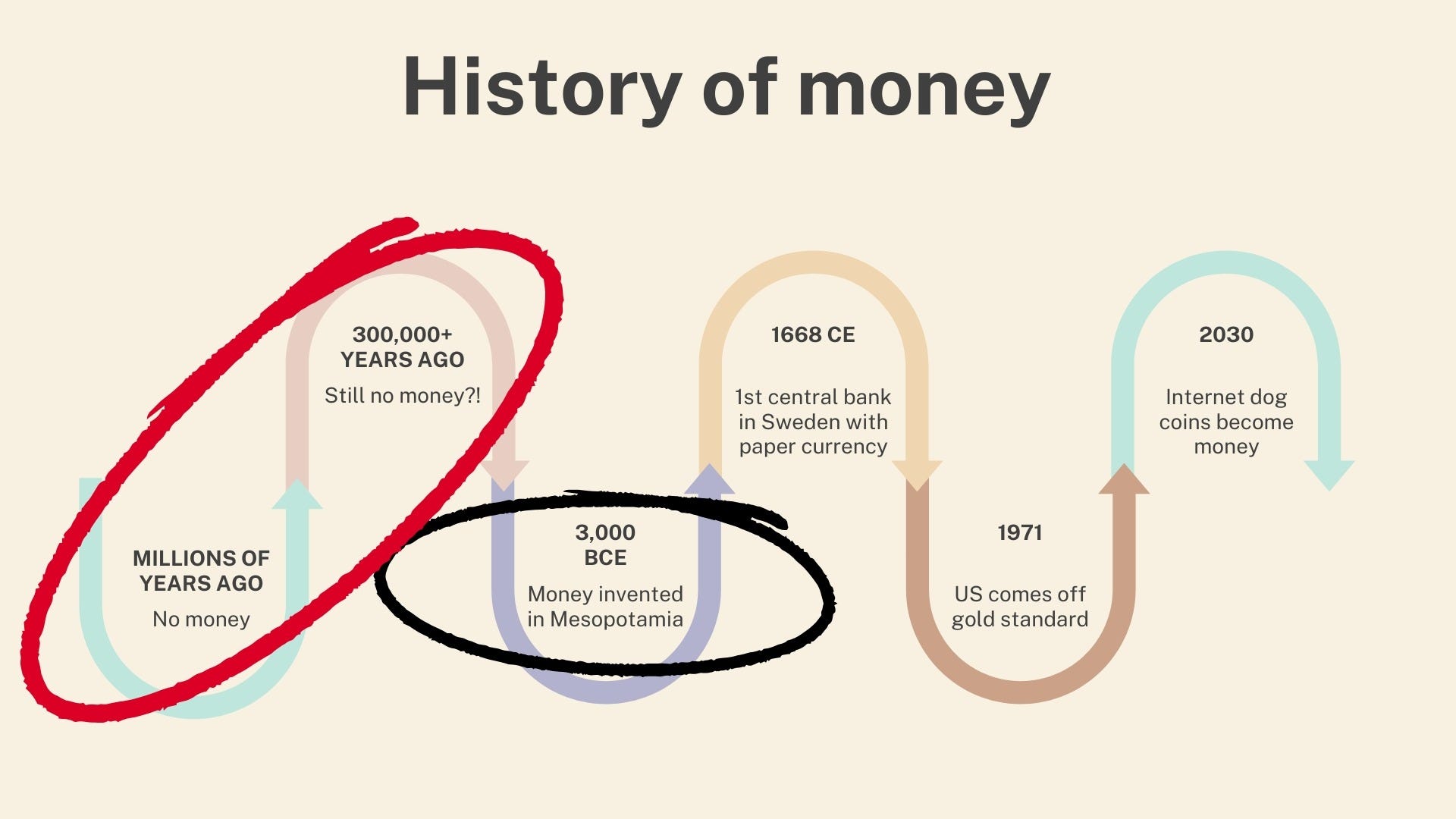
Humans have been around for ~300,000 years and money was only invented about 5,000 years ago. Am I the only person wondering what kind of economy we had before money? The kind of economy that we had not just for hundreds of thousands of years, but maybe even longer?
What Actually Happened Before Money
Marcel Mauss was one of the most brilliant anthropologists of his day. And in 1925, he published an essay called The Gift that changed everything. In it, he explored this very question: How did humans allocate resources before money?
Turned out to be something called a gift economy. Basically, people just gave each other things.
I know it sounds crazy, but I think the best way to understand a gift economy is by comparing it to a pack of wolves. Let’s say you were in the wolf pack, and you were the best hunter of them all. You even got so good that you could catch an entire deer all by yourself.
Even if you caught tonight’s dinner all on your own, at no point would it ever cross your mind to expect some kind of payment from the other wolves in your pack. You would basically be preventing your own family from getting fed.
Now, think about this from the perspective of evolution: this is not a good survival strategy. If a wolf actually expected monetary payment in exchange for food, the pack would have a harder time surviving, and die out.
And that, ladies, and gentlemen, is why wolves don’t have money. But it’s also why we didn’t have money either. Remember that we used to live in these small nomadic tribes for most of history kinda like wolf packs, and suddenly the gift economy makes a lot of sense.
The people in your tribe were your kin, your family, your everything. Someone in the tribe is hungry and I have food. Why don’t I give them the food? The survival of the tribe means the survival of you. So everyone is going to contribute what they can, but everyone is gunna get what they need.
Instead of buying, selling, or bartering, people “gifted” each other things. As sociologist David J. Cheal describes it, “A gift economy is a system of exchange where valuables are not sold, but rather given without an explicit agreement for immediate or future rewards.”
So if you give Billy Bob what he needs, that’ll come back to you sooner or later when Billy Bob has something you need. It’s like an economy built on good will.
This was a bold claim to make in the early 1900s when Mauss was doing his work. It seems to defy the very logic that built and maintains our civilization. But Muass was exactly right. The gift economy has been confirmed and even expanded upon by dozens of experts like American economist Rachel Kranton, anthropologist Eleanor Harrison-Buck, and British anthropologist Maurice Bloch, just to name a few.
We’ve got real evidence for this. No thought experiments required.
My favorite example of a gift economy actually comes from America’s favorite super villain, Christopher Columbus. When Columbus first landed in Hispaniola, he was shocked by how the native people treated him. As soon as they saw the ship, they swam out to sea, bringing food and gifts. This was something Columbus had never seen before, leading him to describe the natives like this:
“The Indians are so naive and free with their possession that no one who has not witnessed them would believe it. When you ask for something they have, they never say no. To the contrary, they offer to share with anyone.”
That sounds an awful lot like a gift economy, doesn’t it? So does every other first-hand account of “primatives.” But you don’t need to go back in time or visit tribal people to see this in action. You’re already using a gift economy in real life every single day.
You’ve without a doubt done something good for someone you’re close with not because you were trying to get money from them, but because it felt good to do.
Think about the relationship you have with your best friend. If you’re tech-savvy, and you see them struggling to change the font size in Microsoft Word, you’ll naturally step in and help out. You could see this as “tech support work” and charge them for the service, but you don’t. You know that they would do the same for you.
It’s like this with your family too. Imagine how weird it would be if your mom invited you over for dinner and then charged you for how much food you ate. Or expected you to barter your favorite cutlery.
That would be really strange.
That cold-hearted calculation is the kind of thing you would expect from a business owner or your boss, not friends and family. You trust them to pay you back in some way, shape, or form. You don’t need a contract, you don’t even need a handshake, the only thing you need is trust.
For most of human history, this is how the economy actually worked.
Now, the reason it’s so easy for us to think we had a barter economy in the past is because it’s actually a lot like our modern market economy.
Today, you don’t trust the person or business on the other side of the transaction so you need to make sure you “get your money’s worth” right away. You have no relationship with the person on the other side, and no intention of starting one. When the transaction is over, this person is, presumably, out of your life forever.
The only thing on your mind is: how can I get the most for me. You’re looking for maximum extractable value. Consumers and corporations are encouraged to think this way because that’s how a market economy works.
The barter economy is the same basic idea, just without the money.
Oddly enough, the barter economy reminds me of flat earth. It makes a lot of sense if you don’t think about. Sometimes, you need an expert to come in, explain the evidence, and show you why your little armchair theory is actually kinda silly. And just like flat earth, some people still choose to believe in the barter economy, not because it’s the truth, but because they really, really want to.
But just because you want to believe something does not make it true, which brings us to the most important part of the story: why this matters.
The Barter Myth and Its Consequences
Despite being objectively false, we still teach the barter economy as fact in every single economics course. This is the first thing you’ll ever learn about money. It always starts here.
So it’s worth asking, why are we indoctrinating our children with lies? David Graeber gives a pretty good answer. The barter myth, “makes it possible to imagine a world that is nothing more than a series of cold-blooded calculations.”
Our entire economy is built on this idea: reduce life to business transactions. How you feed yourself should be a business transaction. How you entertain yourself should be a business transaction. How you make friends, you guessed it, should be a business transaction.
The more we turn life into a series of business transactions, the more the economy grows, the more number go up.
So we take this cynical idea of human nature, we look back into our past, and we project our own perversion onto our ancestors. “Of course they were cut-throat and cold-blooded too, just as self-interested and fucked up as we are.”
According to the story, this is what life has always been, one big business transaction, where the only thing worth doing is profiting at the expense of your fellow human being. What else is there? What else could there even be?
And even when all the evidence contradicts this blatant bullshit, we’ll still teach it to your children as fact. God forbid anyone found out the truth! They might not be so happy about their lives being reduced to a series of business transactions for some imaginary number to go up.
Today, we brainwash our kids with the lie of the barter economy.
But imagine how different things would be if we taught them the truth of the gift economy instead?