
AI is Eerie because it Lacks Eros
Art, the window through which a new world is found

Have you ever really looked at something that was AI generated? I mean, really sat with it. Felt it. Gave it a chance to move you—even if you knew it was AI generated?
Probably not, and I don’t blame you. When we see slop, the reaction is normally a combination of anger, despair, and longing for a world where LLMs had never been let out of Pandora’s data center.
But if you can power through those emotions, and continue looking at the six-fingered shrimp Jesus photos—what do you feel? I feel nothing. It’s the same feeling I had as a child instinctively tuning out commercials, mentally reducing them to the mechanical screeching they always were.
There’s a meme that popped up as ChatGPT went viral, and resurfaces every now and again. It goes something like this:
You feed a few talking points to AI to make it “sound more professional” and email the result to a co-worker who uses AI to summarize it. The first place I saw this meme was, ironically enough, a work chat. It had more reactions than any joke that’d been posted before. But… why? The meme was painfully, excruciatingly true. I shamelessly performed both sides of that meme. Everyone did.
AI is billed as a productivity tool or a creativity enhancement. But really, it’s about self-erasure. Those professional sounding work emails lack even the faintest hint that a living, thinking, feeling human being had been involved in any part of the process. AI is like taking line edits directly from the superego. It puts the should in the cold shoulder.
And for the record, that’s fine for work. Fuck work and fuck writing work emails. Your boss doesn’t want your unique presence anyway.
But what about when presence is the entire point?
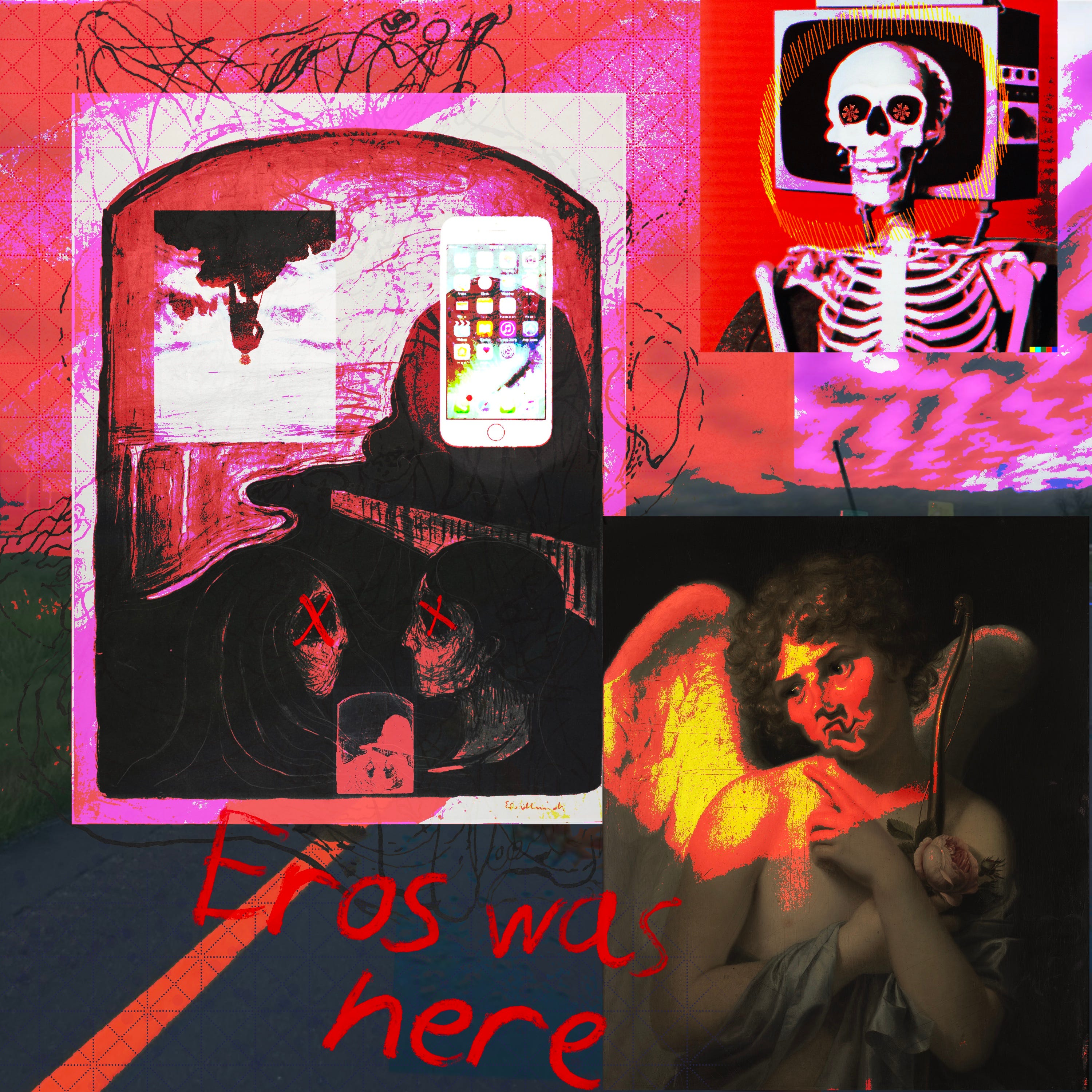
When it comes to social media, art, and human connection generally, we don’t want some data-driven amalgam, we want the presence of other people. Real people. We want personal vulnerabilities, hard-won life lessons, the kind of wisdom that comes from years of both experiencing senseless pain and paradoxically finding meaning in that pain.
This is precisely what AI generated art lacks: human presence. If Mark Fisher were still alive, he might call it eerie in that it contains a “failure of presence.” The pre-AI world carried the implication that behind every piece of art, there was an artist. This is, regrettably, no longer the case.
Art, as a “product of the mind,” is mistaken as an abstraction. And the way to create better art, the thought goes, is by simply adding more mind. This is the cultural logic that spawns so much excitement for AI generated art.
But really, what great cultural achievements has AI generated? Everywhere it is used, people turn their heads in disgust. And the counter-examples say more about those with bad or underdeveloped taste than they do about AI’s “artistic innovation.” AI excels only at producing more mechanical screeching. When people complain that AI art lacks humanity, what they really mean is that it lacks a human body.
“Body am I entirely, and nothing more; and soul is only the name of something in the body.”
—Friedrich Nietzsche, Thus Spoke Zarathustra.
The artistic process is an embodied process. Art is a product of a series of creative decisions—decisions made by a living body which carries a lifetime of experiences.
Just think about the sheer vastness of your unconscious mind. Every single memory. Every skill you fought to refine. Every painful sensation that pierced your veil of aloof comfort. Imagine every experience of your life were transformed into a spirit who guided your hand throughout the creative process in ways that not even you will ever fully understand. The art is an artifact of the totality of you. And witnessing the artifact offers a glimpse into your inner subjective world. It is unmistakably yours: your pain, your joy, your body. Your human presence.
By contrast, AI has no lived experience to draw from. It can only remix and regurgitate what it was trained on. Any given decision is a mere calculation, lacking a genealogy. The result is something that looks like art at a glance but lacks the human presence that makes art valuable in the first place.
When art has that presence, and you allow yourself to experience it as intimately as you can—the person who puts the book down will be different than the one who picked it up.
When you allow an artist’s work to change you in this way, it is indistinguishable from love. “When you fall in love” Anne Carson writes in Eros the Bittersweet, “you feel all sorts of sensations inside you, painful and pleasant at once: it is your wings sprouting. It is the beginning of what you mean to be.”
Has an artist ever done that for you? My personal example is Kafka’s Metamorphosis. The story is about a man who hates the job he needs, whose creaturely side takes over completely and prevents him from working. Incapable of subjugating himself any longer, he is left behind to die like an animal.
The Metamorphosis helped me find the beginning of what I mean to be, helped me sprout wings. It changed me. It changes me every time I re-read it. Kafka’s writing has an erotic effect on me—not in a sexual sense, but as an indirect encounter with his otherlyness. It helps me to not only process my own alienating career, but to stumble closer to who I mean to be.
When I read his novels, I am bearing witness to his human presence—a presence that is uniquely his, and his alone. A presence shaped by every time his father abused him, every time he felt like an inadequate failure, every time he showed up to the job he couldn’t quit. All of those experiences—consciously or not—shaped his writing.
Kafka is assuming a role I like to call the Artist-Other: someone who is so intimately present in their work that to encounter the art is to encounter the artist. This seems to be the key ingredient for great art, and it is precisely what AI will never be able to generate.
I seriously doubt AI could ever create the erotic, transformative effect painstakingly produced by the great Artist-Others of history. And before anyone rushes to say, “but people can’t tell the difference between AI generation and the real thing anymore” which is largely true, and will only become more true as LLMs improve. But is that really art? Or is content you glance at for five seconds before scrolling along?
In a recent interview, Hank Green described brain rot as content that holds your attention without providing any additional value. That’s what AI generates. No one sprouted their wings or found who they mean to be with brain rot from those six fingered shrimp Jesus photos. And that’s a real tragedy because slop is crowding out art that does have that effect—depriving people of discovering what might change their lives.
“Erotic experience presumes the asymmetry and exteriority of the Other.”
—Byung-Chul Han, The Agony of Eros.
Have you ever immersed yourself in art, and stepped back with an “oh fuck” moment? The kind of eureka realization you weren’t even looking for but it dramatically changes you?
This is what makes art worthwhile. Moments like that. Moments of unexpected growth. Moments where you clumsily stumble closer to who you mean to be. And it’s weird because you’re finding who you mean to be by witnessing someone else. It’s almost paradoxical. Maybe Hell is other people, as Sartre reminds us, but Heaven also seems to be other people.
I think Sartre was talking about the painfully common experience of hostility we find in modern life. Where everything is a cut-throat competition. Where, in order for you to win, someone else has to lose. Han said that, “Finding success validates the One through the Other. Thereby, the Other is robbed of otherness and degrades into a mirror of the One—a mirror affirming the latter’s image.”
This is what our hyper-competitive culture does to us: empowers us to reduce our fellow human beings into mirrors that affirm our own narcissism. It’s a painful, miserable, humiliating experience. One that I’m agonizingly familiar with.
I spent a few years working in the tech industry and instead of building or improving products… I found myself flattering C-suite egos as a ghost-writer. My job was, quite literally, to act as a validating mirror for the executives.
They never wanted honest feedback. They never wanted my thoughts. My job was to take their half-baked ideas and massage them into something that would impress the world, that would solidify their position as a “thought leader” for an audience that, honestly, doesn’t really exist. I had been objectified, and the object I was reduced to was a mirror reflecting someone else’s flattering unreality.
Unsurprisingly, I was replaced with AI which is much better at being a mirror of the one. Shortly after they laid me off, one of the executives posted to their public LinkedIn profile to brag about it. “Why hire humans ever again when you can get AI to do it?” he wrote alongside multiple laughing emojis. In a few short months, he got his answer.
The mechanical screeching had, apparently, driven him mad. He announced that he was stepping back from his “research” because he was suffering from AI psychosis. The man stared into the mirror of the one for so long that he had to step away from an executive position and seek mental help.
Schadenfreude. Contrapasso. Ecstasy.
But the situation also highlights that AI psychosis may not be entirely new, and some version of this was already taking place with high power business executives and politicians with their entourage of yes men. Whether it is a CEO and their right-hand sycophant or the latest and greatest LLM, the commonality is this: a lack of Eros.
This is exactly what’s wrong with AI generated art, or maybe AI in general. It’s eerie. There is no human presence in it. No pushback or reflection or nuance. No sense of the other. There’s just what Han calls the “Hell of the same.” A well-designed mirror that drives you toward psychosis if you look at it for long enough.
Art is the opposite of a mirror; it is a window into the Artist-Other opening up a new world of possibility for those brave enough to look. To be changed by art is an erotic experience.
Really interesting piece and something I feel every time I work with AI. I started using Unsplash images for my posts because I was feeling that emptiness from the AI-generated art, even if it could be funny-ish.
Your piece makes me think about how AI is an average of other thoughts. While we are innately limited, which is what makes each of our art unique and interesting, AI averages all that out and lathes it to emotionlessness. I do think we're living through an odd time when we have lost much of the monoculture that used to connect us: no network news at night, newspapers in the morning, and pop culture in between. Now we all watch, read, and listen to our finely curated, individually optimized shit, which is cool, but we don't share that anymore. The one thing we do share comes back to AI, boiling us down to our common parts and spitting it back at us. Maybe we find value in that eventually.
For now, it mostly sucks.
Thanks man, I needed this reminder. I’m caught up in the AI tool excitement currently, but I’m seriously craving locking myself away and painting for a day. So I will do that very soon.