

“It is easy for me to imagine that the next great division of the world will be between people who wish to live as creatures and people who wish to live as machines.”
—Wendell Berry, Life is a Miracle: An Essay Against Modern Superstition.
Hal Varian, Google’s chief economist, once sketched the future with chilling precision: if you miss a car payment, “Nowadays it’s a lot easier just to instruct the vehicular monitoring system not to allow the car to be started and to signal the location where it can be picked up.”
Here, in a single damn sentence, lies the stark reality of Berry’s division. On one side, the creature: a human being, flawed, perhaps struggling, but possessed of a fundamental autonomy—the right to turn a key and go. On the other, the machine: an invisible system of remote control, where your life is a line-item in a cloud database, and your autonomy can be instantaneously revoked by the cold, calculating panopticon.
This is the quiet, constant war of our existence and we are losing because we’ve been tricked into a devastating surrender.
Jeanette Winterson, quoted by Maria Popova here, called art the “paradox of active surrender.” You yield to the struggle of a profound book, an otherworldly piece of music, a terrifying love poem—and in that surrender, you are broken open and remade. You surrender to the pain of becoming more yourself. More alive.
Surveillance Fascism operates on a demonic inversion of this principle. It offers a passive surrender to end the struggle of being human altogether.
Instead of yielding to a transformative challenge, you yield to the algorithm to stop the challenge. You let Spotify’s AI “DJ” dictate your mood because choosing feels like work. You let the front page of Reddit or TikTok’s FYP decide what you care about today.
We don’t consciously imagine it this way, but we are trading our personal agency for engineered serotonin. Pure frictionlessness. You give in to the pleasure of not having to choose, and you receive in return the deep, psychic pain of a managed existence—the slow, agonizing death of your own interiority. The mask finally swallows the face.
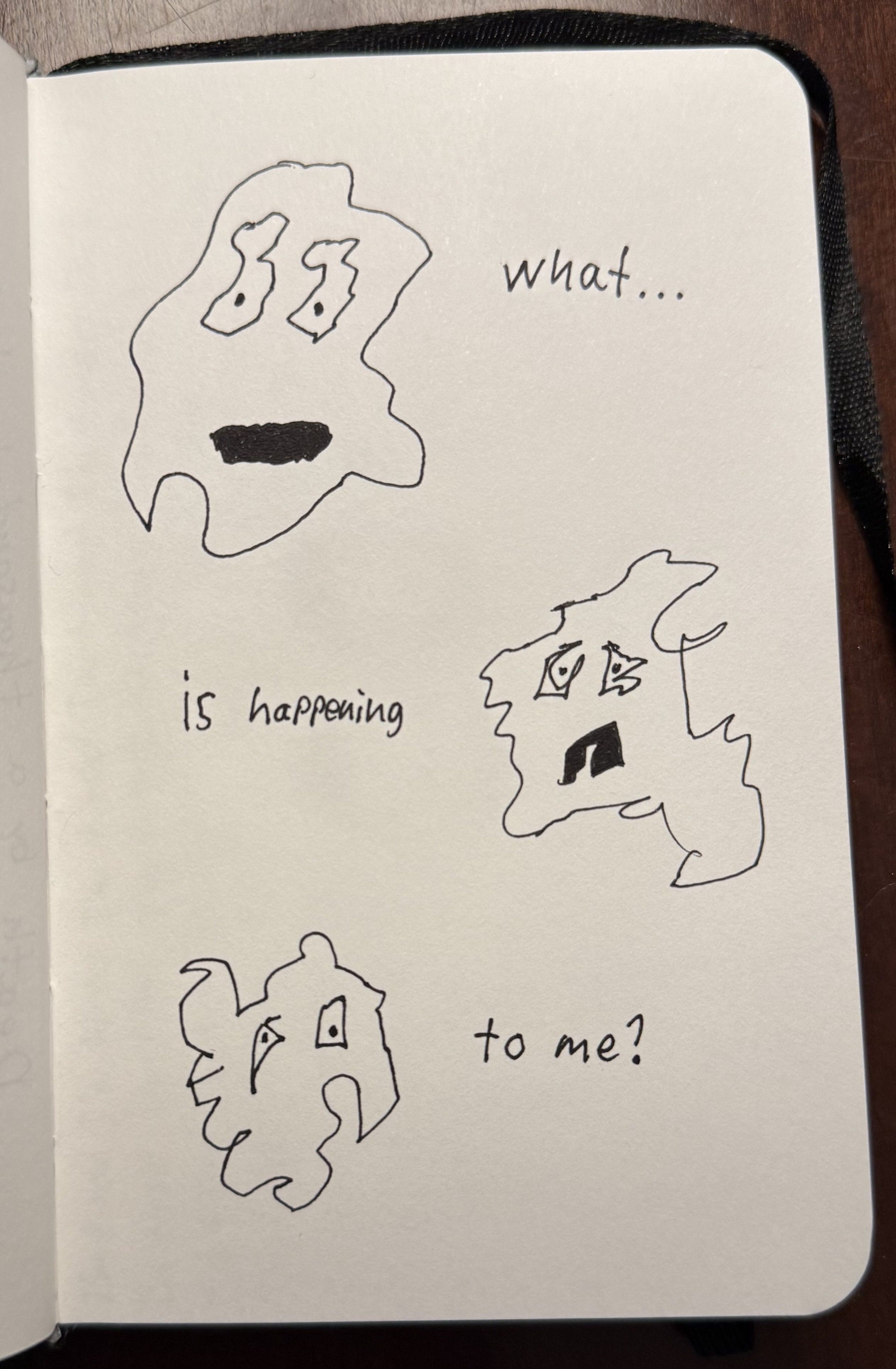
This is the true goal of the system we’ve diagnosed as Surveillance Fascism. It’s not just corporate data extraction weaponized by the state. That’s the machinery. The purpose is the colonization of human inwardness.
Consider how far the project has progressed.
In 2007, Facebook’s “Beacon” broadcast a man’s engagement ring purchase to his entire network—including his girlfriend—shattering a carefully planned proposal. A human moment of vulnerability and love was transformed into a data point for engagement optimization. To the machine, absolutely nothing is sacred. Everything is feedstock, a forest waiting to be cut down and devoured.
Today, the invasion is subsurface. Companies like Affectiva began with a noble aim: to help autistic children understand emotion. But the “market” pulled the way it always does. Their technology swiftly pivoted to measure your subconscious reactions to commercials. What started as a tool for empathy became an instrument for extraction, mining the frontier of feeling that exists before you have words for it.
This is the Death of Interiority: the rendering of your inner life as just another mineable territory.
As Shoshana Zuboff puts it, “The struggle for power and control in society is no longer associated with the hidden facts of class and its relationship to production but rather by the hidden facts of automated engineered behavior modification.”
Class conflict is over. The new division isn’t labor versus capital. It’s modifiers versus modified. Those who engineer behavior and those whose behavior is engineered.
Look at any feed on the internet. The content is conditioning you. It’s owners wield the most asymmetrical power imbalance in human history. Their consolidation of Big Tech now grants them the ability to alter reality at scale, and enforce their new reality with the most violent and dangerous state apparatus on the planet.
In Orwell’s 1984, the “Versificator” was a machine that cranked out cheap culture for the proles. Literature, music, and entertainment generally were generated by a machine thus ridding society of human creativity. The dark alignment between algorithmic social media and generative AI have created for us a kind of modern Versificator. Look no further than Breaking Rust, the AI music project that topped country music billboards late last year.
This is cultural stagnation amplified to a pathological extreme—an extreme that is gradually becoming the banal, new normal. That same year, Zuckerberg announced his cure for the loneliness epidemic: AI friends. Facebook is increasingly prioritizing AI companionship because the real thing—even mediated by seamless social platforms—is too difficult, apparently. His chatbots will even message you first, so your already fractured attention will need to filter out even more noxious distractions.
Most troubling of all is the man-made pandemic of AI psychosis. Users are suffering from paranoia and delusions. It happened to my old boss. My partner—who works as a psychiatric nurse practitioner—has told me that around sixty percent of their patients are dealing with some version of AI psychosis. Some users become disconnected from reality, but many are committing suicide.
AI psychosis and the tragedy of AI-induced suicide represent the totalizing victory of machine over creature.
But the machine’s victory is not inevitable.
Resistance to this quiet terror is simple (and free): a personal, spiritual revolution to reclaim true “active surrender.”
It is to choose, relentlessly, to live as a creature.
To live as a creature is to perform acts of strategic illegibility. It is to become “dark data”—information the machine cannot parse. It is the walk without a step-tracker, where the path is for you, not for a fitness dashboard. It is the book read slowly, for no content-marketing purpose. It is the face-to-face conversation that meanders into awkward, unfiltered territory. It is the conscious cultivation of friction, inefficiency, and mystery in a world demanding seamless, predictable optimization.
Each of these acts is a small strike against the machine. It swaps the demonic surrender—which gives you fleeting pleasure and existential pain—for the creative surrender, which accepts the painful struggle of becoming a specific, authentic human.
Wendell Berry’s division is already here. On one side: those who accept the machine’s terms, living comfortably in the dashboard, their inner lives flattened into usable metrics. On the other: those who commit to the messy, glorious, and inefficient struggle of creaturehood.
The machine’s ultimate victory is not when it tracks you, but when you prefer its tracking—when you willingly trade the aching responsibility of your own consciousness for the serene numbness of an algorithm.
Our rebellion begins the moment we choose our own kind of pain. The pain of living as we are, as we were always meant to embody. A pain that leads to growth. A pain that creates solidarity between our inner worlds and the inner worlds of other creatures—all creatures, stretching back to the very first single-celled organism that kicked off this whacky, wonderful, terrifying experiment we call existence.
Long live creaturehood in absolute defiance of these damned machines.
Like a much needed bucket of water in the face of our digital complacency. Then, while I was still shook by the stark reality check of your words, Substack’s algo put this on my feed:
https://substack.com/@ssdavid/note/c-207136535?r=pkac9&utm_medium=ios&utm_source=notes-share-action
This piece and the following comments blew my mind. These people are actively feeding and surrendering their every thought to the machine, as they are seemingly, and casually, discussing the creation of a digital clone of their entire consciousness.
This is way beyond passive acceptation, this is cult like behaviour. I need a coffee.
This should have something like 500,000 reads