
My Digital Tony: How I Survived a Traumatic Childhood with an Internet Persona
The Dissociative Tool That Saved and Then Rebuilt My Life

Hi, I’m an existential imbecile named Max Murphy. Here on The Murphy Memos we explore the absurdity of existence.
Consider subscribing if you’re into that kinda thing.
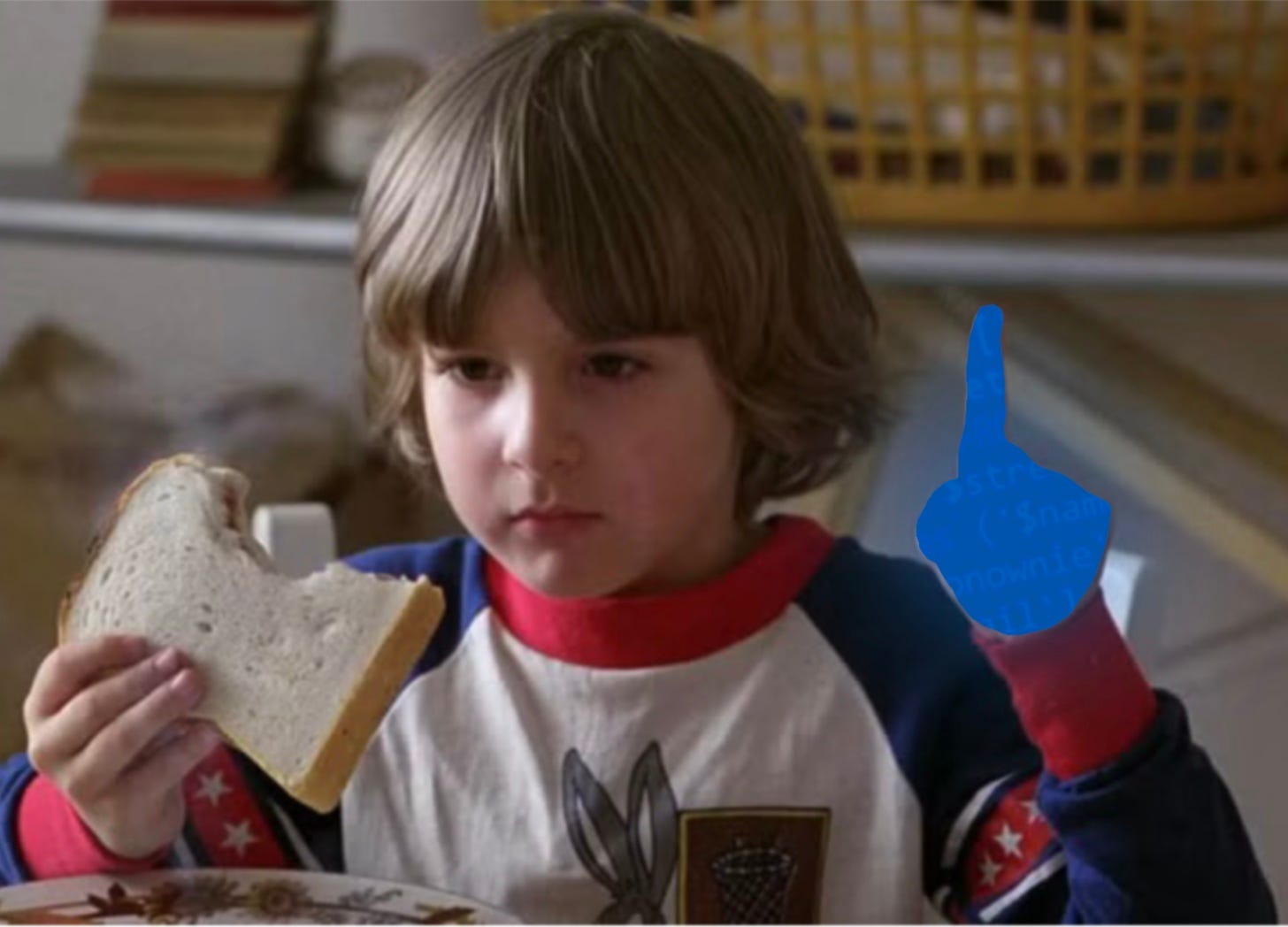
The other night, I popped a weed gummy and watched Stanley Kubrick’s The Shining.
I thought it would be a fun Friday evening. Instead, I stumbled upon a cursed burial ground, accidentally exhuming trauma that sat dormant for decades.
It felt less like a horror masterpiece and more like a documentary loosely based on my own childhood.
But before I tell you about my sad origin story, let’s at least pretend to explore the film.
“Danny’s not here right now” –Tony
The Shining plays with one of my favorite themes in fiction: the split self. A line running straight through the center of a human being, separating two aspects of the psyche that cannot be reconciled.
This theme is often a cornerstone of great horror because it’s uncanny, giving off a feeling of foreboding uncertainty that begs for resolution. And it’s explored brilliantly in Danny’s split persona, Tony.
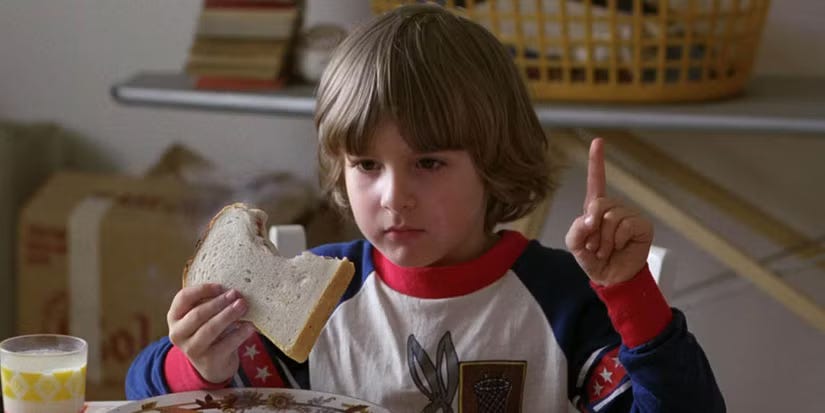
Tony is the part of Danny that “knows things” and can handle them while Danny himself is just a 5-year-old boy. Tony is a dissociative coping mechanism that helps Danny survive his father’s abuse—stemming from the incident where his father dislocated his shoulder in a drunken rage.
What makes Tony so unsettling is that this kind of dissociation is normally not so obvious. Children hide it or at least wait for adults to leave the room. Seeing Danny wiggle his finger, speak in another voice, and claim to be Tony… you can’t help but to feel creeped out.
“Uncanny is what one calls everything that was meant to remain secret and hidden and has come into the open’,”–Freud quoting Schelling in his 1919 essay, The Uncanny.
However, what makes The Shining great is that—in addition to being a memorable horror trope—this also happens to be a real thing.
Abused children often survive traumatic childhoods by dissociating. Normally, it isn’t as weird as having a boy living “inside your mouth” but it is a shockingly common diagnosable disorder.
And it wasn’t until I watched the Shining that I realized… this is exactly how I survived my drunk dad, too.
My dad didn’t dislocate my shoulder, but he did pick me up from football practice absolutely shitfaced, got into a road rage with my best friend’s father, and nearly killed us all on the drive home. It’s a miracle we survived.
I only realized in retrospect that this was a personal turning point. Withdrawing from life completely, I became absolutely obsessed with my internet persona—as if my life depended on it.
“The double was originally an insurance against the extinction of the self or, as Rank puts it, ‘an energetic denial of the power of death’” –Freud, The Uncanny.
In other words, my Internet alter ego was a way for me to deny the primordial fear of death. A death that nearly got me in a drunk driving accident I had no power to control.
My digital Tony was a mask I’d sculpted in the years I spent alone in that dark bedroom glued to a glowing rectangle that represented my entire world.
That probably sounds sad. But my digital tony was more than just a dissociative coping mechanism; it became a legitimate tool to overcome intergenerational trauma.
The caretaker’s script
The Shining’s foreshadowing is heavy-handed by design because intergenerational trauma is predictable by nature. Always has been and always will be.
In one of the film’s most chilling lines, the ghost of a previous caretaker says to Jack: “You’ve always been the caretaker.”
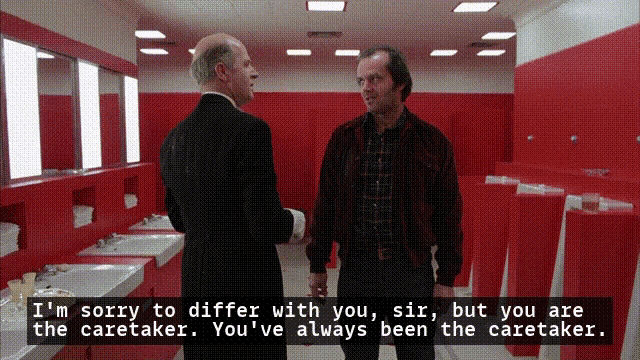
This single line diagnoses a generational curse, highlighting Jack’s complete lack of agency. He’s following a script written by ghosts of the past—a script of addiction, abuse, and violence. We can infer that Jack was once a little boy, terrified of his own drunk dad, just like how Danny is terrified of him.
This is a script I know by heart. In my family, those pages were stained with budweiser. My grandfather was also a drunk, a man who drank himself to an early grave. In turn, my father followed the same tragic arc.
You’ve always been the caretaker, dad.
This is the insidious power of the unconscious. As Carl Jung warned, “Until you make the unconscious conscious, it will direct your life and you will call it fate.” My father and Jack1 both followed the script to its terrible conclusion as if destined.
I was next in line.
The icing on the cake was that my father never even bothered to give me my own name. I am, begrudgingly, a “junior.”
My father’s name was given to me like a hand-me-down suit that reeked of cheap beer. It never felt like my own. It felt like a role I was destined to play: a drunk fool who fucked his kids up. The next caretaker of my family’s trauma.
But I refuse to repeat the past.
This is why my internet persona became so important. It was the only way to drop my placeholder name, cast the script into the flames, and write a different story—one that was truly my own.
My digital Tony was never a single, static character. It was a menagerie of masks accumulated over the years that let me transcend my shithole life circumstances, culminating in… ugh, whatever this is.
Directing your own life like this is empowering. It feels like you literally move the stars to change your own fate.
The internet is how I made the unconscious conscious. I could see the script, and in seeing it, I could choose something else. Anything else.
Was this all just some abstract fear? Nope. I know this curse was written into my genes because I watched my brother fall into the same tragic pattern, thankfully without bringing children into it. I might never be a popular Substack writer, but I broke this generational curse, and that’s accomplishment enough for lil ol’ me.
I don’t drink. Tried wine once and didn’t care for it.2 More importantly, I have never operated under my legal name online. The aliases I chose—sometimes a gamertag, sometimes a pen name—are my declaration of independence.
They are the names of the person I was building, free from the curse of the one I inherited.
In a very real way, the “junior” my father named—the boy fated to become the next caretaker—was killed in that drunken car ride.
Who was built in my computer’s glowing screen was someone new.
I’d like to imagine that’s what Danny did, too: that Tony helped him survive at first, but so that he could see the cycle, burn the script, and kill the caretaker once and for all by not becoming him.
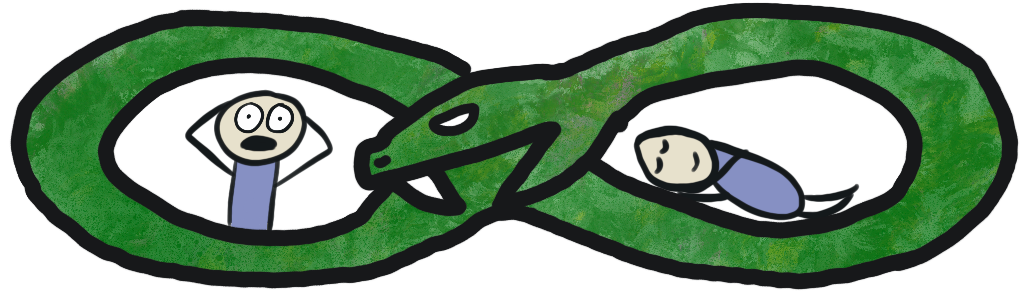
Reintegration
Not very long ago, I made a “brand decision” to retire my cartoon pfp and use my real face3:
This turned out to be a bit more than a brand decision.
The cartoon was just another mask of a boy trying to hide from the world. But I longed to be a man seen by the world.
That’s probably why it felt “cringe.”
The cartoon served its purpose, and became dated.
Using my real face felt like a way to drop the dissociative coping mechanism, but keep the powerful tool for personal transformation thing. My self esteem even went up by 27%
Some pages of your script need to be burned to make space for new ones.
And the internet, for all its bullshit, offers you a fire. So start setting shit on fire, start writing your script. Start making the unconscious conscious. Start rearranging the stars to change your own destiny.
If you’re already doing that—or plan on starting after reading this—please share in the comments! I would love to see how you’re making the unconscious conscious, changing yourself, and maybe even changing the world.
If you found this essay entertaining, informative or disturbing… be sure to subscribe (or upgrade to paid)! Not many people are shameless enough to psychoanalyze themselves in public like this.

this is fucking surreal bc my grandfather’s name was Jack
Funny enough, I made this decision before watching The Shining, though the two events seem intimately connected.
Congratulations Max! My Tony is the fighter/athlete mask that I created after stopping drinking and most drugs... and I evertually became this person it seems. Or maybe I always was, but was programmed into being someone else by my lived experiences.
I love this jungian analysis Max you’re doing an awesome job transmuting all that pain into something meaningful and quite frankly needed !